Wireless Site Survey NY Challenges: Real New York Building Conditions
New York is not an easy wireless environment.
A clean office floor in Midtown has different problems than a warehouse in Brooklyn, a medical office in Queens, a brownstone in Manhattan, or a multi-tenant commercial building in Long Island City. Concrete, brick, steel, glass conference rooms, elevator shafts, neighboring WiFi networks, crowded 5 GHz channels, poor cable paths, and locked IDF closets can all change the design.
That is why guessing usually gets expensive.
A wireless site survey gives you a measured view of the space before you spend money on more hardware, more licenses, more cabling, or another installation that may not solve the problem. We look at the building, the RF environment, the existing equipment, the way people use the space, and the actual business needs behind the network.
For some clients, that means fixing dead zones. For others, it means planning a new office buildout, validating a recent installation, preparing for more employees, supporting warehouse scanners, improving roaming for voice, or designing a network that can handle guests, staff, security devices, and business systems at the same time.
What Is Included in a Wireless Site Survey?
A wireless site survey should leave you with more than a vague recommendation to “add more access points.”
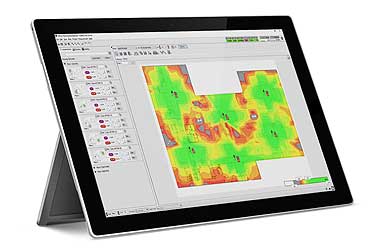
The scope changes from project to project. Sometimes the work starts with a floor plan and a predictive design. Other times, we are on-site checking signal, interference, channel use, AP placement, mounting options, cable paths, and the spots where users are actually having trouble. Heatmaps may be part of the report, but they are not the whole point. The useful part is knowing what needs to move, what needs to be added, what can stay, and what the installer or IT team should do next.
We also look for the practical issues that often get missed during a rushed design. Can the AP actually be mounted where the drawing says it should go? Is there a cable path? Is the ceiling too high? Are there areas where aesthetics matter? Are there walls or glass partitions that will change the signal? Is the existing switch infrastructure ready for more APs? Is the current WiFi controller or cloud platform still the right fit?
Those details matter because wireless design does not stop at the heatmap. Someone has to install it, manage it, and live with the result.
When a Wireless Site Survey Is Worth Doing
A site survey makes sense when guessing could send the project in the wrong direction.
That happens a lot with WiFi. Someone adds a few APs because the signal feels weak, but the real issue is interference. Or they replace the internet circuit because calls are dropping, when the problem is actually roaming between access points. In a warehouse, scanners may only drop in two or three spots, but those spots are right where the work happens. In an office, the WiFi may seem fine until the conference rooms fill up and everyone joins video calls at the same time.
Those are the kinds of problems that are hard to solve from a desk.
A survey is usually worth doing before a new buildout, office move, AP refresh, warehouse expansion, or any project where cable is about to be run. It is also useful when the network is already installed but nobody is confident it was designed correctly. Maybe users are complaining. Maybe the AP count feels wrong. Maybe the floor plan changed since the original install. Maybe the business needs a real report before approving the next round of work.
Not every WiFi issue needs a full survey. Sometimes a quick review is enough to find the obvious problem. But once the space has multiple floors, dense users, warehouse aisles, treatment rooms, classrooms, event areas, POS systems, security devices, or anything the business depends on every day, it is usually better to measure first. It is cheaper to catch the problem before the hardware is bought, the cable is pulled, and the same weak spots are still there after the install.
Predictive, Active, and Validation Surveys
Different projects need different types of survey work.
A predictive wireless survey is usually done before the network is built. We use floor plans, building details, expected wall materials, access point models, and coverage goals to estimate AP placement and signal coverage. This is useful for new offices, early budgeting, construction planning, and cabling layouts.
An active wireless survey is done on-site. We measure the actual RF environment in the building and look at coverage, noise, interference, signal strength, roaming behavior, and the way the existing network performs. This is usually the better choice when the WiFi is already installed but not working well.
A post-install validation survey checks the finished network. This is where we confirm whether the installation matches the design and whether the coverage, roaming, and performance are where they need to be. It is especially useful after a new deployment, office buildout, or access point upgrade.
In many New York projects, the best answer is a mix. A predictive design may help with planning and cabling. An active survey may be needed once the space is accessible. A validation survey may be needed after the install so the final system can be tuned properly.
We Look Past the WiFi Bars
Full bars can be misleading.
A laptop can show a strong signal and still have a bad connection. We see that all the time. The access point may be close enough, but the channel is crowded. Or the device is hanging onto an AP down the hall instead of roaming to the one nearby. Sometimes there are too many APs in one area and not enough in another. Sometimes everyone blames the internet circuit, but the real problem is happening inside the wireless network.
That is why we do not judge a space solely by signal strength.
On a survey, we look at how the network behaves in the places people actually use it. Conference rooms, warehouse aisles, nurse stations, packing areas, POS counters, shared offices, back rooms, and high-traffic areas usually tell you more than an empty hallway. We check coverage, noise, interference, channel use, roaming, AP placement, cabling options, and whether the hardware aligns with how the space is being used.
A weak spot is not always just a weak spot. If it is in a back hallway, maybe nobody cares. If it is where scanners are used all day, or where payment terminals sit, it becomes a real problem. The same goes for cameras, phones, tablets, and conference rooms. We look at what is actually running on the network before deciding whether the layout makes sense. Otherwise, the design can look fine on paper and still be wrong for the building.
Wireless Site Surveys for Offices
Office WiFi problems often show up in conference rooms first.
The space may seem fine when people are working at desks, but once a meeting starts and everyone opens a laptop, joins a video call, and connects a phone, the weakness becomes obvious. Glass walls, dense seating, huddle rooms, neighboring tenant networks, and poor AP placement can all cause problems.
For office surveys, we usually look at user density, conference room requirements, roaming, guest access, AP placement, cabling options, and whether the current design still matches the way the office is being used.
This is especially important in New York offices where layouts change often. A floor that was designed for open desks may now have more meeting rooms. A space built for 40 people may now hold 90. The WiFi design has to keep up with the real use of the office, not the old floor plan.
Wireless Site Surveys for Warehouses and Industrial Spaces
Warehouses are a different problem.
High ceilings, metal racks, inventory, forklifts, loading docks, scanners, tablets, and long aisles all affect wireless coverage. A basic office-style AP layout usually does not work well in that kind of space.
A warehouse survey is easy to get wrong if you only look at the drawing. The real issues usually show up in the aisles, around the loading dock, near packing stations, or anywhere handheld scanners are in constant motion all day. Racks change the signal. Inventory changes again. So do forklift paths, ceiling height, and where the APs can actually be mounted. We walk those areas with that in mind. Not every corner of the warehouse matters the same way. The network has to hold up as people scan, pick, pack, and move product.
A warehouse may look simple on a floor plan, but the RF environment can change once racks are filled, equipment is moving, and handheld devices are roaming through the space.
Wireless Site Surveys for Event Venues and Public Spaces
Event venues need a different kind of planning because the room can change from one day to the next.
A venue may be empty during the survey, but packed during an event. That changes the wireless environment. People absorb signal. Booths, staging, lighting, production equipment, registration desks, and temporary walls can all affect coverage and capacity.
We work on many temporary networks for events, trade shows, productions, conferences, and brand activations, so we tend to look at venues a little differently. A ballroom or exhibit hall can look simple when it is empty. Then the event loads in, the room fills up, booths go up, registration opens, production starts pushing traffic, and the weak parts of the network show up fast.
When we survey a venue, we are thinking about more than normal guest WiFi. Registration, POS, show management, production, exhibitor demos, livestreaming, green rooms, and back-of-house areas all pull on the network in different ways. The building may have WiFi already, but that does not mean it is ready for event day.
Wireless Site Survey Cost in New York
Wireless site survey pricing depends on the size of the space, the number of floors, the type of building, the level of reporting needed, and whether the survey is predictive, active, or post-install validation.
A small office survey may be relatively straightforward. A multi-floor commercial space, warehouse, school, healthcare facility, or event venue usually requires more planning, more measurements, and a more detailed report.
The biggest cost factors are usually:
- Square footage
- Number of floors
- Ceiling height
- Floor plan quality
- Building materials
- Existing network complexity
- After-hours or weekend access
- Required reporting detail
- Number of SSIDs, device types, or use cases
- Whether the project includes design, validation, or troubleshooting
We do not recommend paying for more survey work than the project needs. If a lighter assessment is enough, we will say that. If the space needs a proper active survey before anyone touches the cabling or buys hardware, we will say that too.
What You Get After the Survey
The final deliverable depends on the scope, but the purpose is always the same: give you a clear next step.
A finished wireless site survey report may include heatmaps, AP placement recommendations, problem areas, interference notes, equipment guidance, cabling considerations, installation notes, and tuning recommendations. In some cases, the report is used by our team for the final deployment. In other cases, it is handed to an internal IT department, cabling vendor, MSP, construction team, or building owner.
We write the report so it can be used in the real world. That means clear enough for decision makers, detailed enough for technical teams, and practical enough for the people who have to install the network.
Wireless Site Survey Service Area in NY
Made By WiFi provides wireless site survey services throughout New York City and the surrounding NY metro area, including:
- Manhattan
- Brooklyn
- Queens
- The Bronx
- Staten Island
- Long Island
- Westchester
- Northern New Jersey
- Nearby commercial and industrial areas in the NY metro region
We also support national clients with multi-site wireless survey and network design work, but New York is our home market. That gives us a practical understanding of the buildings, access issues, RF conditions, and project timelines common to this area.
Why Work With Made By WiFi?
A wireless site survey is only useful if the person doing it understands what happens after the survey.
Access points have to be mounted. Cable has to be pulled. Switches need enough PoE. VLANs, SSIDs, security settings, and controller settings have to be configured. Users need to roam. Guests need to connect. Business systems need to work. And when something breaks, someone has to know where to look.
Made By WiFi is not just a survey company. We design, install, manage, and support wireless networks in real environments. That changes how we survey. We are not just trying to produce a report. We are trying to prevent the problems that show up later during installation, cutover, or daily use.
That is the difference between a survey that looks good on paper and a survey that helps you make the right decision.
Request a Wireless Site Survey in New York
If your WiFi is unreliable, your office is expanding, your warehouse has coverage gaps, or you need a wireless design before an installation, Made By WiFi can help.
Send us the floor plan if you have one. Tell us what is not working, what devices need to connect, and what the space is used for. From there, we can recommend the right level of survey work and give you a clear path forward.
A good wireless network starts with understanding the space. The survey is where that work begins.
Frequently Asked Questions About Wireless Site Surveys in New York
What is a wireless site survey?
A wireless site survey is an on-site or plan-based assessment used to understand how WiFi will perform in a specific space. It looks at signal coverage, interference, access point placement, building materials, user density, cabling paths, and the applications the network needs to support.
Do I need a wireless site survey before installing WiFi?
A small office or simple retail space may not need a full survey. But once the building has multiple floors, warehouse aisles, classrooms, treatment rooms, event areas, or a lot of people using WiFi at the same time, it is better to check the space before the install starts. Otherwise, you can end up buying APs you do not need, missing areas that do need coverage, or running cable to locations that looked fine on paper but do not work well in the building.
What is the difference between a predictive and active wireless survey?
A predictive wireless survey is created from floor plans before the network is installed. It is useful for early planning, budgeting, AP counts, and cabling layouts. An active wireless survey is done on-site using real measurements from the building. It is usually better for troubleshooting, validating an existing network, or confirming how the space actually behaves once walls, racks, people, and neighboring networks are part of the picture.
Do you provide WiFi heatmaps?
Yes. When heatmaps are part of the scope, we can provide coverage maps showing expected or measured wireless performance across the space. Heatmaps are useful, but they are only one part of the survey. The real value is understanding what the results mean and what should be done next.
Can you survey an existing WiFi network that is already having problems?
Yes. Many surveys are done because an existing network is slow, unreliable, or inconsistent. We can review the current access point locations, signal levels, interference, roaming behavior, channel usage, and hardware configuration to identify the likely causes.
How much does a wireless site survey cost in NYC?
The cost depends on square footage, number of floors, building type, survey type, reporting detail, and access requirements. A simple office survey will cost less than a multi-floor building, warehouse, school, or venue. The best way to price the survey is to review the floor plan, current problems, and project goals.
Can your survey report be used by our internal IT team or another installer?
Yes. The survey report can be used by your internal IT team, cabling vendor, MSP, installer, or building team. We can also handle the full design and installation if you want one team responsible for the project.
Do you only provide wireless site surveys in New York?
No. Made By WiFi provides wireless site survey services in New York City, the NY metro area, and nationwide. The New York page is focused on our local service area, but we also support clients with multi-site and out-of-state projects.